Carnival 1950 - 1959
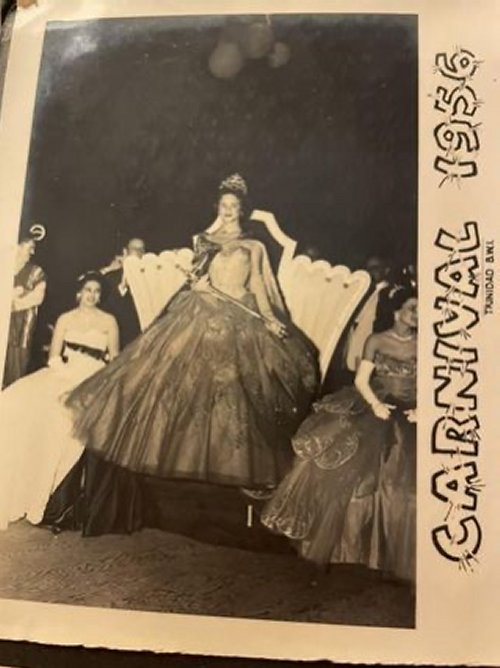
Carnival in the 1950s, like everything else in Trinidad at that time, reflected the racial and social makeup of the island. While Whites and mulattoes joined together, Blacks had their separate bands; rarely did East Indians take part in the celebration. Some of the so-called "White bands" were transported on trucks as they were driven through the streets of Port-of-Spain, sometimes showering gifts such as toothpaste samples on the spectators. Parading the streets on foot in costume (playing mas) was perceived as a "Black thing." Competition was held at both the Queen's Park Oval, where the Carnival Queen (see 1956 Queen) was selected on the Sunday night before Carnival, and the Queen's Park Savannah, where the Calypso King was crowned the same night. Bands paraded at these two venues on Carnival Monday and Tuesday and competed for prizes. However, the Oval's parade of bands was more elitist since the Governor of Trinidad and Tobago and the Carnival Queen would be in attendance. On the streets, each parading band had its own live music supplied by either brass (conventional music bands) or steel (steelbands). Although there was an almost equal number of brass bands and steelbands on the streets, brass bands such as John "Buddy" Williams set the tempo for the revelers.
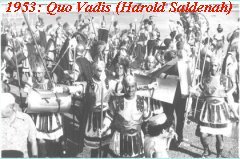
In the 1950s, bands were greatly influenced by Hollywood movies of the 1940s and 1950s with historical presentations such as Quo Vadis (Harold Saldenah, 1953) and Ten Commandments (Irvin McWilliams, 1957). With the challenge to look authentic, paper-based outfits were replaced with metal, where possible, and created opportunities for metal-crafters such as Ken Morris to make an impact on Carnival working with copper. The following videos captured Trinidad Carnival during the early part of this decade: 1950s; 1950s.
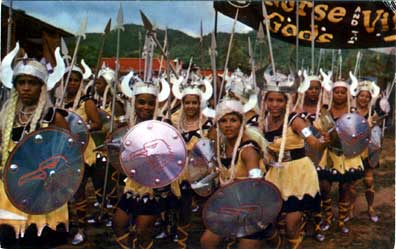
By the mid-1950s, mas became very competitive and a "Band of the Year" award was initiated in 1955 to recognize the effort that was being put into the presentations. In 1956, participation was on the increase and more than ten bands crossed the Queen's Park Savannah stage with more than 300 masqueraders. From 1957 to 1959, the Band-of-the-Year first place winner was awarded $500. In 1957, an innovative bandleader from Woodbrook, Port of Spain, by the name of George Bailey made a stunning appearance on the mas scene, at the young age of 21, and changed the face of Carnival forever. The authenticity of his presentation Back to Africa won Bailey Band-of-the-Year honors that year when he beat back other breathtaking presentations such as Irwin McWilliams' Ten Commandments and Harold Saldenah's The Glory That Was Greece. The extensive research that was reflected in the splendor of Bailey's presentation compelled others to follow suit in future years. For a look at a video of 1957 Carnival, click here.
The "Band of the Year" competition was a challenge that had been accepted by steelbands in the late-1950s. During this period, steelbands such as Starlift of Woodbrook used the "Fancy Sailor" category to gain recognition as one of the Top Five Bands of the Year, with presentations such as Undersea Kingdom and Nursery Rhymes. In 1959, another prize called the "Band of the People's Choice" was initiated.
During the decade, the Band-of-the-Year awards were won by Harold Saldenah (2.5), George Bailey (2), and Bobby Ammon (0.5). Other large bands during this period were led by Neville Aming, Harry Basilon, Stephen Lee Heung, Horace Lovelace, Irvin McWilliams, and Errol Payne. The following is a listing of the presentations of the winners of the Large Band-of-the-Year competition during the 1950s:
|
| |||||||||||||||||||||||
E-mail to: Ronald C. Emrit
Copyright © 2000-2012 All rights reserved.